7-Day Machame Route: Kilimanjaro Itinerary, Price and What to Expect
7 days on the mountain
About 62 km (39 mi)
Tented camps
From $2,090 per person
Why the 7-day Machame Route is the classic Kilimanjaro climb
If you ask a dozen people who have climbed Kilimanjaro which route they took, most will say Machame, and there is a good reason for it. In seven days, you walk through every climate zone on the mountain, from dripping rainforest to the ice at the top, and you come down a different path from the one you went up. It is often called the "Whiskey Route", because it is harder than the Marangu "Coca-Cola Route", and it has the best variety of any route at this price.
The 7-day version follows the same trail as the 6-day, but adds a night at Karanga Camp, so you reach high camp rested and with more time at altitude behind you. Prices start from $2,090 per person, with a guide, five porters and a cook for each climber. For most first-time climbers on this side of the mountain, this is the climb we recommend.
7-day Machame climb at a glance
Route
Machame up, Mweka down
Days on the mountain
7 days, 6 nights in tents
Total distance
About 62 km (39 mi)
Start and finish
Machame Gate (1,800 m / 5,900 ft), Mweka Gate (1,650 m / 5,410 ft)
Summit
Uhuru Peak, 5,895 m (19,341 ft)
Difficulty
Hard, but well paced
Best seasons
January to mid-March, June to October
Price
From $2,090 per person, two sharing
Why the extra day on the Machame Route is worth paying for
On the 6-day climb, you walk from Barranco to Barafu in one long day and start for the summit a few hours later. Here, you split that walk with a night at Karanga, reach Barafu at lunchtime and have an afternoon to rest. It costs $245 more per person, and it changes how summit night feels.
Operators publish very different summit figures and none are independently audited, so treat any single number with caution. Commonly quoted ranges run from about 27 to 42 percent on 5-day climbs, and from about 64 to 92 percent on 7-day climbs, with 8 and 9-day climbs reported higher still. The exact figures matter less than the pattern: more days means better odds.
Is the 7-day Machame Route right for you?
Choose it if you want the classic Kilimanjaro walk and sensible pacing without paying for a longer trip. It is a strong fit for regular hikers who enjoy a physical challenge.
It may not suit you if you want solitude, because Machame is busy in peak months, especially at Barranco. For quieter trails and one more day, look at the 8-day Lemosho climb. If the thought of the Wall worries you, or you are climbing in a wetter month, the 7-day Rongai climb is the gentler choice for the same price.
7-day Machame itinerary, day by day
Here is how the 7-day Machame climb runs from gate to gate. Distances and walking times are typical figures, and your guide will set a pace that is slower than you expect. You also spend one night in a Moshi hotel before the climb and one after it.
01
Day 1: Machame Gate to Machame Camp
Sleep at 3,028 m (9,930 ft)
About 11 km (7 mi), 5 to 7 hours
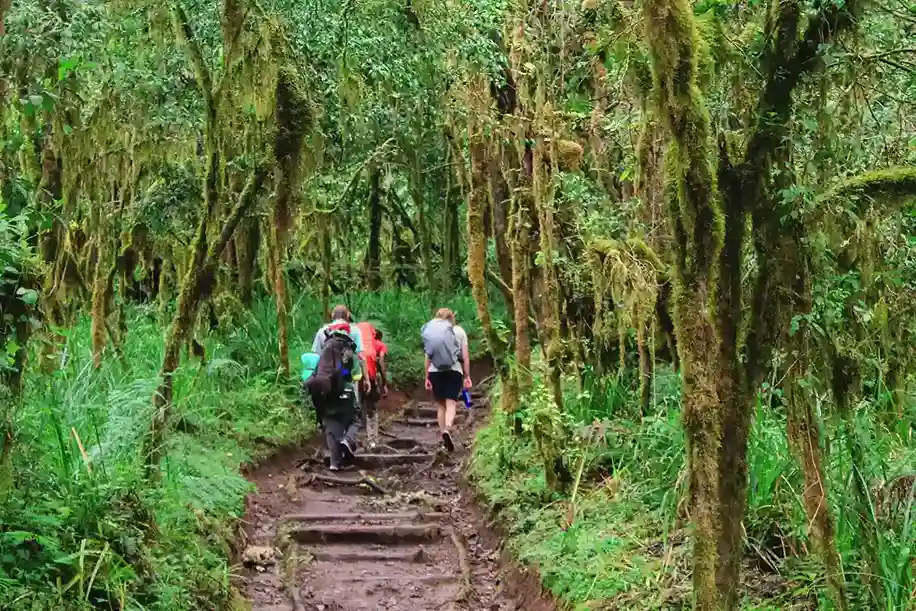
We collect you from your Moshi hotel in the morning and drive about an hour to Machame Gate (1,800 m / 5,900 ft), where your guide completes the park registration while the crew weighs the loads. The path then climbs steadily through montane rainforest, wet underfoot after rain and full of moss and giant ferns. Look up for colobus monkeys. Walk slower than feels natural, even on this easy first day, because the habit you set now pays off on summit night. Your crew passes you on the trail and has camp ready at the forest edge when you arrive.
02
Day 2: Machame Camp to Shira Camp
Sleep at 3,840 m (12,600 ft)
About 5 km (3 mi), 4 to 6 hours
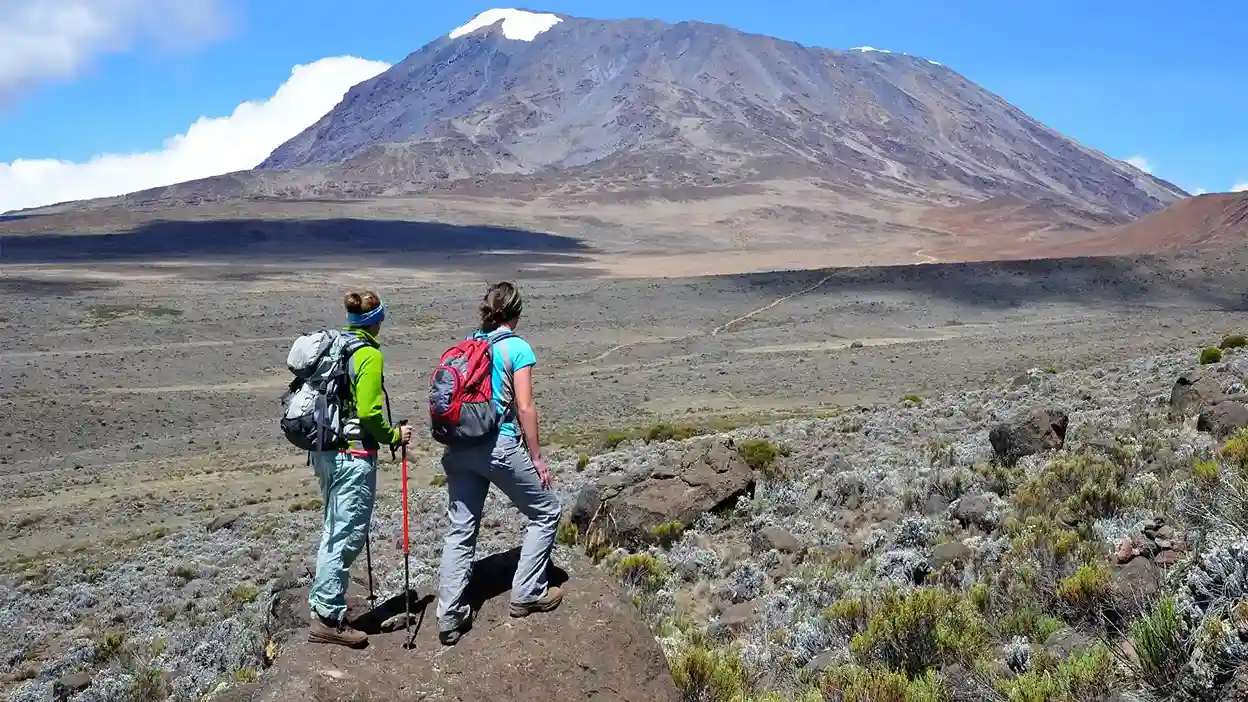
The forest gives way to giant heather and open moorland almost as soon as you leave camp. The distance is short, but the path is steep and rocky in places and you gain about 800 meters (2,600 feet), so this is the first day many climbers feel the altitude. Shira Camp sits on the edge of the plateau. On a clear evening you see Kibo ahead of you and Mount Meru floating above the clouds behind you, and the temperature drops quickly once the sun goes down, so have your warm layers ready.
03
Day 3: Shira to Barranco Camp via Lava Tower
Sleep at 3,976 m (13,040 ft)
About 10 km (6 mi), 6 to 8 hours
This is the day that does the most for your acclimatization. You climb through bare alpine desert to Lava Tower (4,600 m / 15,090 ft), a volcanic plug that is the highest point you have reached so far, and eat lunch there. Then you drop more than 600 meters (2,000 feet) to sleep at Barranco. Headaches at Lava Tower are common and usually ease on the way down, which is exactly how "climb high, sleep low" is meant to work. Tell your guide how you feel. The last hour of the descent passes through a valley of giant groundsels.
04
Day 4: Barranco Camp to Karanga Camp
Sleep at 4,035 m (13,240 ft)
About 5 km (3 mi), 4 to 5 hours
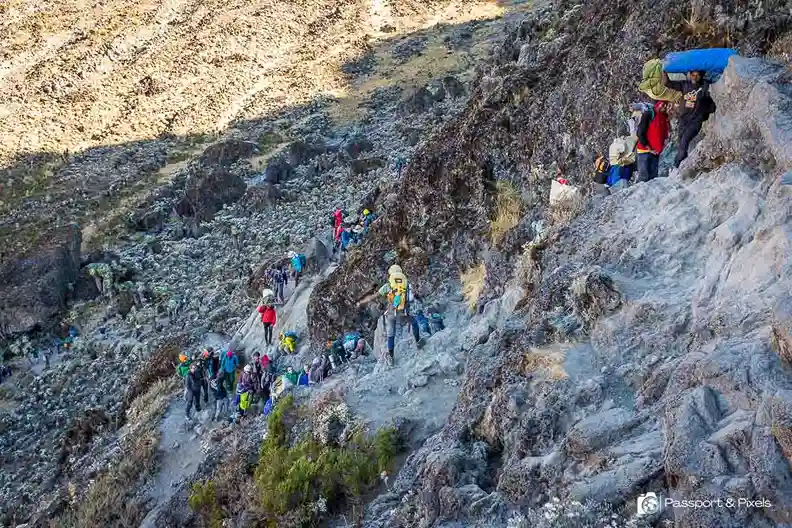
The morning starts with the Barranco Wall, a 250-meter (820-foot) scramble that looks far more intimidating from camp than it feels on the rock. You use your hands in a few places, and your guide will show you where to step, but it needs no ropes and no climbing experience. From the top, the glaciers of the southern icefields seem close enough to touch. The path then rises and falls across valleys to Karanga, where you arrive by early afternoon. Use the extra time to rest, eat and drink, because this easy afternoon is why this schedule works.
05
Day 5: Karanga Camp to Barafu Camp
Sleep at 4,673 m (15,330 ft)
About 4 km (2.5 mi), 3 to 4 hours
A short, slow climb over bare rock takes you to the high camp. Barafu means "ice" in Swahili, and the camp is exposed, windy and cold. You arrive around lunchtime, eat, and go through the summit plan with your guide. Lay out your layers, charge what you can, fill your water bottles and try to sleep by early evening. Few people sleep well here, and that is normal. Rest is what matters. You will be woken around 11 p.m. for tea and a snack.
06
Day 6: Barafu to Uhuru Peak, then Mweka Camp
Sleep at 3,100 m (10,170 ft)
About 17 km (10.5 mi), 11 to 15 hours
You leave around midnight and climb steep volcanic scree by headlamp, in temperatures that can fall to around -20°C (-4°F) with wind. It is slow and mentally tough, and most climbers find the hours before dawn the hardest of the whole trip. Stella Point on the crater rim (5,752 m / 18,871 ft) usually comes around sunrise, and Uhuru Peak (5,895 m / 19,341 ft) is about an hour further along the rim. After photos you descend to Barafu for food and a short rest, then continue down to Mweka Camp. Trekking poles help your knees a great deal on this descent.
07
Day 7: Mweka Camp to Mweka Gate
Finish at 1,650 m (5,410 ft)
About 10 km (6 mi), 3 to 4 hours
The final morning is a walk through rainforest on tired legs, and the thick air feels wonderful. The path can be slippery after rain, so stay careful even though the hard part is over. At the gate you sign out and receive your certificate: Uhuru Peak earns a gold summit certificate, and Stella Point earns a green one. Then we drive you back to your hotel in Moshi for a long shower and your second included night.
How hard is the Machame Route on 7 days?
The Machame Route is demanding without being technical. It has steeper sections than Marangu or Rongai, and the Barranco Wall needs some use of your hands, although no ropes. The hardest part is not the terrain, though. It is summit night, when you climb about 1,200 meters (3,900 feet) in the dark and the cold, after days at altitude. Fit climbers who have trained on long, hilly walks manage the walking well. Altitude is what decides most summit attempts.
The 7-day schedule helps with all of this. Your days on the upper mountain are short, and you arrive at Barafu with enough time to rest before you leave for the top.
Summit night on the Machame Route: what to expect
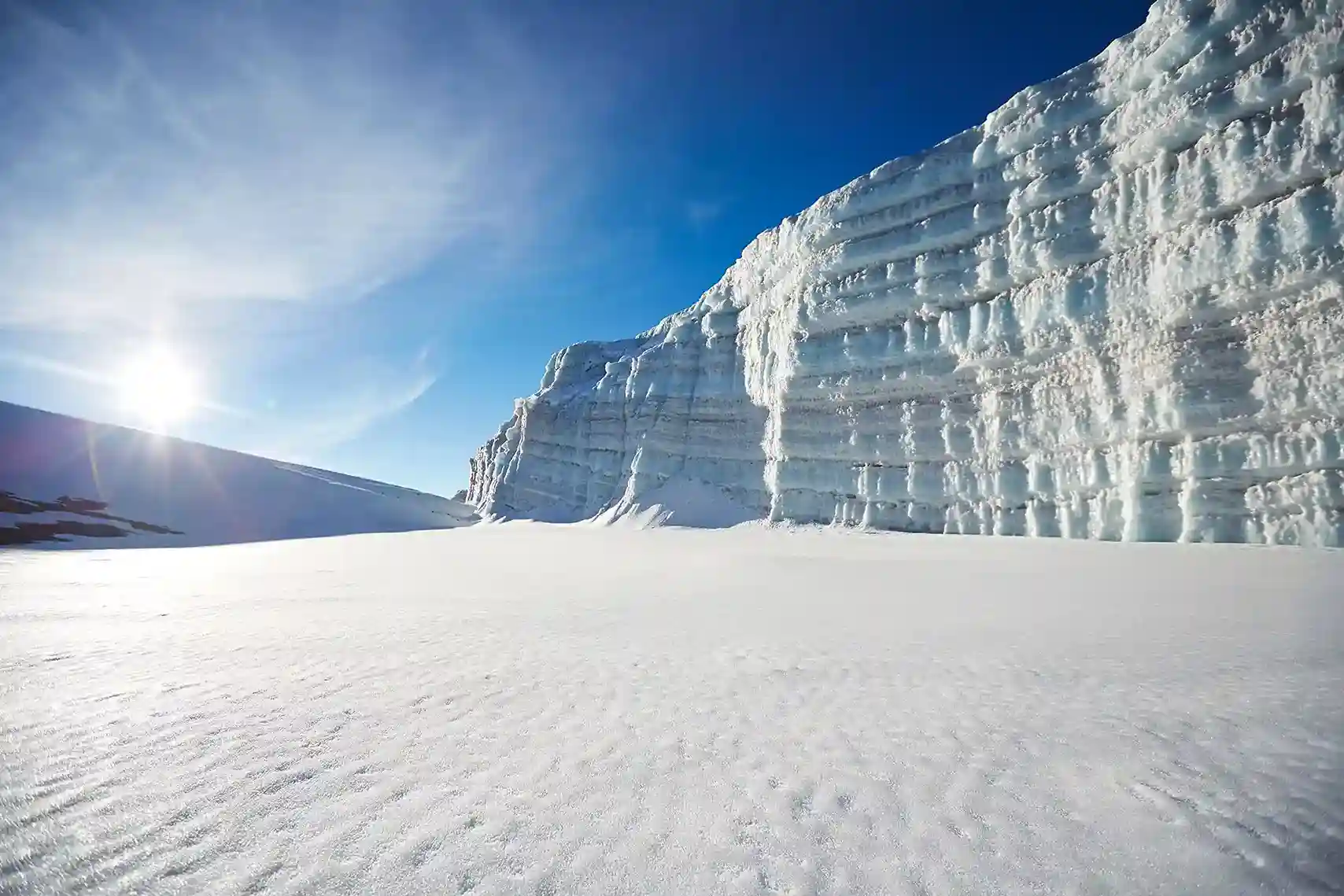
Summit night on the Machame Route starts from Barafu, and it is the hardest stretch of the climb. You follow a line of headlamps up long zigzags of loose scree for around 6 to 8 hours, and it can be windy and very cold. Stella Point arrives around dawn and gives you the first real feeling of success. From there, the walk around the crater rim to Uhuru Peak takes about an hour, with glaciers on one side and Africa spread out on the other. Wear every layer you have and keep your water in an insulated bottle so it does not freeze.
How much does the 7-day Machame climb cost?
The 7-day Machame climb starts from $2,090 per person with two people sharing. Prices differ slightly by group size because of how hotel rooms are shared in Moshi, not because of your crew, who are arranged per climber. For more than six climbers, or a different hotel level, ask us for a quote. Your final price is confirmed in your written quotation.
Group size
Price per person
1 climber
$2,130
2 climbers
$2,090
3 climbers
$2,125
4 climbers
$2,090
5 climbers
$2,110
6 climbers
$2,090
What the 7-day Machame price includes, and what it leaves out
Included
Return airport transfer in Tanzania
Two nights in a mid-range hotel in Moshi, before and after the climb
Transport between Moshi and the park gates
Park fees: entry, camping and rescue
One guide, five porters and one cook for each climber
Three meals a day and drinking water on the mountain
Tents, dining tent and sleeping mats
Pulse oximeter checks, emergency oxygen and a Gamow bag
Pre-climb briefing in Moshi
Not included
International flights
Tanzania visa
Travel insurance, which is required and must cover trekking to 6,000 m (19,685 ft) and evacuation
Helicopter evacuation, which starts from $3,500 per person if needed
Sleeping bag and trekking poles, which you can bring or rent in Moshi
Clothing and personal gear
Tips for your crew
Extra hotel nights and drinks other than water
Budget separately for flights, your visa, insurance and tips. Our Kilimanjaro cost guide shows what to expect in total, so nothing catches you out.
Your crew and safety on the Machame Route
Every climber on our Kilimanjaro climbs has one guide, five porters and one cook. A group of two therefore has two guides, ten porters and two cooks. That ratio is higher than many operators offer, and it means that if one climber needs to slow down or turn back, the other can continue with their own guide.
Our guides have worked on Tanzania tours for 7 years. They are graduates of the College of African Wildlife Management, Mweka, and the National College of Tourism, and they hold certification from those institutions. We are also a partner of the Kilimanjaro Porters Assistance Project (KPAP), which works for the fair treatment of mountain crews.
Altitude is the main risk on this climb
Mild headaches and poor sleep are normal above 3,000 meters (10,000 feet). Severe symptoms are an emergency, and the treatment is to go down. Be honest with your guide about how you feel each day, and read our guide to altitude sickness on Kilimanjaro before you travel. We carry pulse oximeters to track your blood-oxygen levels each day, emergency oxygen cylinders for emergency descents and severe altitude illness, and a Gamow bag, a portable pressure chamber used to treat advanced altitude sickness. Helicopter evacuation is available through providers including Kili MedAir and Proflight Helicopters, with fees starting from $3,500 per person. It is not part of the climb price, so check that your travel insurance covers trekking to 6,000 meters (19,685 feet) and evacuation before you buy it.
How much to tip your crew
Tips are paid at the end of the climb and are not in the price. Common guidance is about $20 to $30 a day for a guide, $12 to $20 for a cook and $5 to $10 for each porter. With our crew of seven, that works out at about $400 to $700 per climber on this 7-day climb. We go through how to do this fairly at your briefing.
Planning your 7-day Machame climb
Best time to climb the Machame Route
The driest months are January to mid-March and June to October, and these are also the busiest on Machame, especially July to September. If you want quieter trails in a dry month, January, early June and late October are good choices. Machame is wetter than the northern side in the rainy months, and the forest section gets very muddy, so we do not suggest it in April or May for first-time climbers. Our month-by-month guide goes into more detail.
Getting to the start of the Machame Route
Machame Gate is about an hour's drive from Moshi, so this is one of the easier starts. We collect you from your hotel in the morning and handle the registration at the gate while you get your daypack ready. The climb finishes at Mweka Gate, also about an hour from Moshi, and we drive you back. Fly into Kilimanjaro International Airport (JRO), about an hour from Moshi, and we meet you there.
Preparing for 7 days on the mountain
Start training at least 12 weeks before you travel, with long hikes on back-to-back days. Our Kilimanjaro training plan shows you how, and our packing list covers what to bring and what you can rent in Moshi. Two nights in a mid-range Moshi hotel are included by default, one before and one after the climb. If you would prefer a different standard, tell us and we will adjust your quote.
After the climb
Your legs will need a day or two, and then many climbers add a northern circuit safari. We can build this into one quote.
7-day Machame climb: your questions answered
Why take 7 days on the Machame Route instead of 6?
The extra day splits the walk from Barranco to Barafu in two. You sleep at Karanga, reach Barafu by lunchtime and have an afternoon to rest before the summit attempt. It gives your body more time to adjust and makes summit night less of a shock.
How cold does it get on summit night?
Temperatures near the top can fall to around -20°C (-4°F) with wind. Good layers, warm gloves and a warm hat matter more on this night than at any other time. See our Kilimanjaro packing list.
Where do I stay before and after the climb?
Two nights in a mid-range Moshi hotel are included by default, one before and one after the climb. If you would prefer a different standard, tell us and we will adjust your quote.
Do beginners climb the 7-day Machame?
Yes, many do. You do not need climbing experience, but you do need good fitness. Our training plan explains how to prepare.
Is the 7-day Machame better than the 7-day Lemosho?
They cost the same and share the same upper mountain. Machame has the easier start and a shorter second day, and Lemosho has quieter early days. If you value solitude, choose Lemosho.
Can I join a group for this climb?
We run private climbs and have no joining dates of our own. If you would like company, we can ask trusted partner companies whether one of their departures matches your dates, at the same price with nothing added.
Ready to book your 7-day Machame climb?
Tell us your dates and how many are climbing, and we will send a full quote from our office on Mawenzi Road in Moshi.