5-Day Northern Circuit Safari
From $3,040
View itinerary
Lake Manyara National Park is small, but there is much more to it than its size suggests. In just a short drive, you pass from shady forest to open floodplain to the shores of a soda lake, all beneath the steep western wall of the Rift Valley.
This guide explains what the park offers and how to fit it into your trip. For trips, see our Lake Manyara safari tours.
| Location | Below the Rift Valley wall, between Tarangire and Ngorongoro |
|---|---|
| Size | About 325 square kilometers (125 square miles) of land, plus the lake |
| Established | 1960 |
| Known for | Tree-climbing lions, forest, birds and flamingos |
| Best time | June to October for animals, November to June for birds |
| Nearest town | Mto wa Mbu |
Groundwater forest greets you at the gate, thick with fig trees, baboons and blue monkeys. Further in are acacia woodland, floodplains and hippo pools. The lake itself is shallow and alkaline, and it changes in size with the seasons.
Expect elephant, buffalo, giraffe, zebra and hippo, along with a great number of birds, including pelicans, storks and flamingos when water levels suit them. The park's tree-climbing lions are famous, although sightings are far from certain.
June to October suits large mammals. November to June suits birds, including migratory species. Some tracks can get difficult in the heaviest rains.
The park is about four hours from Moshi, on the main road to the crater and the Serengeti. A single game drive, usually in the afternoon, is enough for most visitors. The nearby town of Mto wa Mbu, whose name means "river of mosquitoes", has a lively market and cultural walks.
Prices are at mid-range level with two people sharing. For route advice, see our Lake Manyara safari guide.
From $3,040
View itinerary
From $3,605
View itinerary
From $4,230
View itinerary
From $5,215
View itineraryThe park sits at the foot of a dramatic wall, part of the Great Rift Valley, which runs through East Africa. The Gregory Rift escarpment rises steeply above the forest here, and the road to the Ngorongoro highlands climbs right up it. From the top, you get a superb view of the lake and the park below. Springs that flow from the base of the cliff feed the park's forest, which is why it stays so green.
Over 400 species have been recorded in this small park, making it one of the finest places in northern Tanzania for birds. Look for pelicans, storks, kingfishers and hornbills. Flamingos may arrive in large numbers when water levels suit them, turning the shoreline pink, although that does not happen in every month. The hippo pool near the north of the lake is a good place to stop and watch.
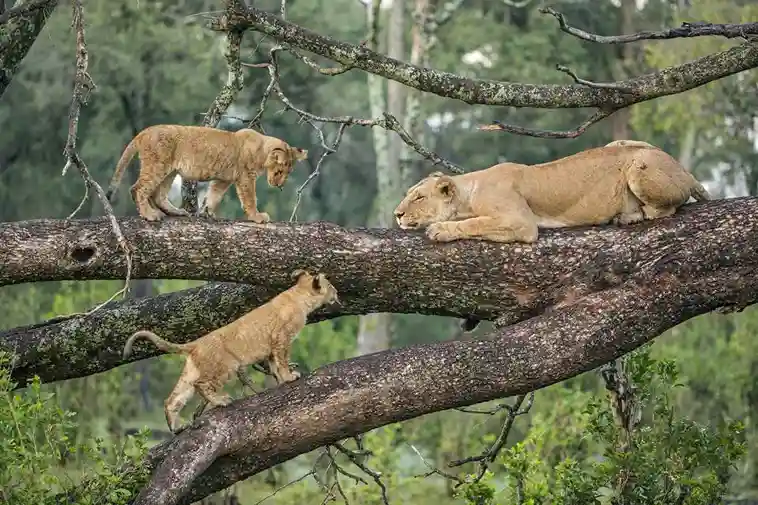
Lions do not usually spend much time in trees, but here they have made it famous. No one is sure why. Perhaps they want to escape flies or get a breeze. Sightings are far from guaranteed, and you may not see them, so think of them as a bonus. Tarangire and the Serengeti can also have lions in trees at times.
Mto wa Mbu, the town at the gate, is a lively mix of more than 100 ethnic groups, and it is a good place for a guided walk through its banana farms and market. Some lodges on the escarpment offer forest walks. Canoeing on the lake may also be possible, depending on water levels. Tell us if any of this interests you, and we will check what is available.
Most lodges and camps are outside the park, either near Mto wa Mbu or on the escarpment, which has wonderful views. A few are inside. Staying here is a useful stop between Tarangire and the Serengeti, as it breaks a long journey. We will suggest places at your level, and we will tell you what to expect from each.
If you only have time for one, most people choose Tarangire, particularly from June to October, for its elephants and larger size. Lake Manyara is better in the wet months and for birds, and it offers more variety in a small space. On a trip of five days or more, you do not have to choose, and they sit close together.
It suits travelers who enjoy scenery and birds, as well as those on a longer trip. If you have just two or three days, we usually suggest spending them elsewhere, but if you are passing by with a free afternoon, it is well worth a visit. It also works as a relaxed first game drive after a long flight, before the bigger experiences ahead.
The name is thought to come from a Maasai word for a plant used to make livestock enclosures. The park was established in 1960. Ernest Hemingway once called it one of the loveliest places he had seen in Africa, according to a story often told, and its setting below the Rift Valley wall easily explains why. It later became known for elephant research, carried out by Iain Douglas-Hamilton.
The lake is shallow, and its size and color change with the rain. In wet years, it can fill much of the park's floor. In dry years, it may shrink back from the shore, leaving wide mudflats. That explains why flamingo numbers vary so much, as they feed on algae that grow in certain conditions. Ask your guide what the lake is doing when you arrive.
The forest is shady, so you will need a steady hand or a higher ISO for monkeys and baboons. By the lake, the light is much brighter, and a zoom lens helps for birds. Late afternoon is best, when the sun lights up the escarpment. From the top of the Rift Valley wall, on the road to Ngorongoro, stop for a wide view over the lake and the park.
From here, the road climbs the escarpment to the Ngorongoro highlands and continues on to the Serengeti. Tarangire is about an hour and a half away. Combine them on a northern circuit safari.
A single game drive of three to four hours is enough for most people. If you are a keen birder, you may want a full day. Most visitors stay one night nearby, as a stop on the way to the Serengeti. See our Lake Manyara safari guide.
No one is entirely sure. It may be to escape flies or to catch a breeze, and sightings are not guaranteed.
One game drive is enough for most people.
No. Numbers vary with the water levels.
Yes, on a trip of five days or more.
Add it to a safari of five days or more, as a change of scene on the way west. Send us your dates, and we will build it in.
Tell us when you are traveling and what interests you, and we will build your itinerary.