What is the best route to climb Kilimanjaro?
For most first-time climbers, it is the 8-day Lemosho. It combines quiet trails, good scenery and time to adapt. The 7-day Machame is a very good lower-priced alternative.

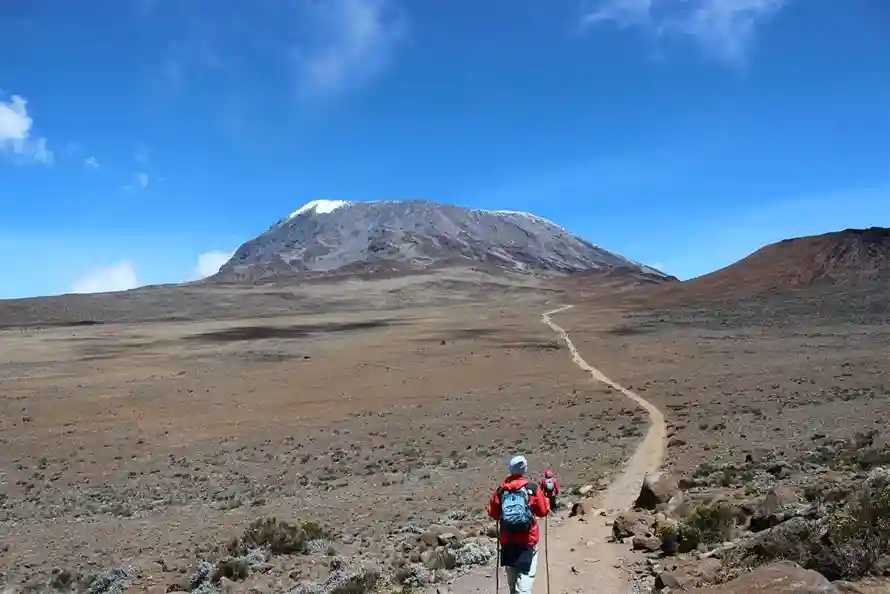
Choosing a route is the biggest decision you will make before you climb Kilimanjaro, and it is easy to get wrong. Every route reaches the same summit at 5,895 meters (19,341 feet), but they are not interchangeable. Book the shortest one to save a few days or a few hundred dollars, and you may make the climb far harder than it needs to be.
Our team runs climbs on five Kilimanjaro routes from our office in Moshi. For most first-time climbers, we suggest the 8-day Lemosho, with the 7-day Machame as a lower-priced alternative. This guide explains why, how each route differs, and how to match one to your fitness, your schedule and what you want from the trip.
Here are the five routes we run, side by side. Two more exist: Umbwe, a steep route for experienced trekkers, and Shira, which shares much of its path with Lemosho from a higher start. We do not offer them as standard because they suit fewer climbers.
| Route | Days | Start | Sleep in | Crowds | Best for |
|---|---|---|---|---|---|
| Machame | 6 or 7 | South | Tents | Busy | Scenery and value |
| Lemosho | 7 or 8 | West | Tents | Quiet at first | First-timers with time |
| Marangu | 5 or 6 | South-east | Huts | Busy | People who prefer huts |
| Rongai | 6 or 7 | North | Tents | Quiet | Wetter months, no scrambling |
| Northern Circuit | 9 | West, then north | Tents | Very quiet | Most time to adapt |
Distances are about 62 km (39 mi) for Machame, 70 km (43 mi) for Lemosho, 72 km (45 mi) for Marangu, 73 km (45 mi) for Rongai and 90 km (56 mi) for the Northern Circuit. Figures vary slightly with the exact path.
Only one route, Marangu, has huts all the way. You sleep on a bunk in a shared dormitory, eat in a dining hall and stay dry when it rains. The trade-off is a fixed set of stops and a schedule that leaves less room for acclimatization.
Every other route uses tents, which our crew carries and sets up before you arrive. Camping sounds harder, but it is what makes longer itineraries possible, and longer itineraries are what give you better odds at the top. Do not avoid tents out of habit. Your crew handles the heavy work, and most people are surprised by how comfortable a well-run camp can be.
Machame is the most popular route on Kilimanjaro for good reason. It climbs through rainforest and moorland, passes Lava Tower and crosses the Barranco Wall, then comes down a different path. It takes 6 or 7 days, and the 7-day version is the one we recommend. Expect company in peak months. Read our Machame Route guide.
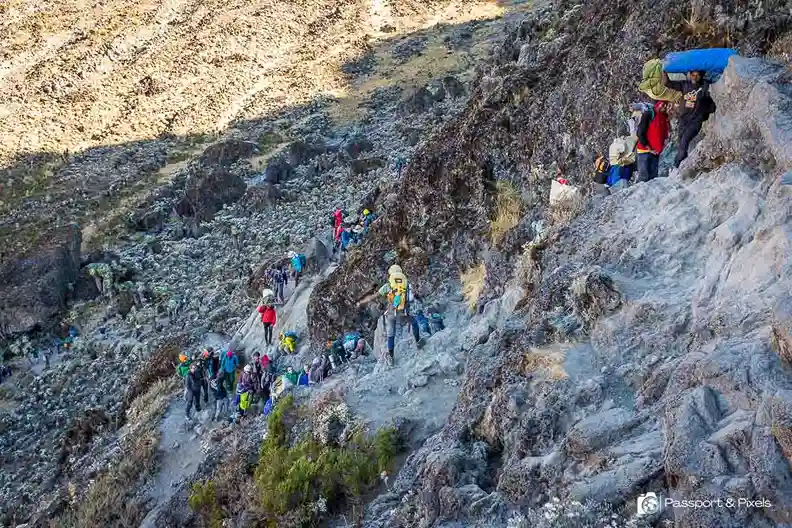
Lemosho starts on the remote western side and crosses the Shira Plateau before joining Machame near Lava Tower. It takes 7 or 8 days. The first few days are quiet, the views are excellent and the pacing is kind to your body. It is the route we recommend most often. Read our Lemosho Route guide.
Marangu climbs from the south-east on a gentle path and comes down the same way. It takes 5 or 6 days, and we strongly suggest 6. Its easy reputation is misleading, because the walking is gentle but the height gain is fast. Read our Marangu Route guide.
Rongai is the only route that approaches from the north, near the Kenyan border. It tends to be drier and is one of the quietest routes on the mountain, with no scrambling. It takes 6 or 7 days. The early scenery is less dramatic, but the night at Mawenzi Tarn is a real highlight. Read our Rongai Route guide.
The Northern Circuit starts like Lemosho, then circles the rarely seen northern slopes. It takes 9 days and gives you more time to adapt than any other route, with very few people around you. If you can spare the time, it is hard to beat. Read our Northern Circuit guide.
Most climbers ask which route is easiest. A better question is how many days you can give the mountain, because time is the biggest factor you control. Your body needs days to adjust to thinner air, and it does not care which trail you are on.
Operators publish very different summit figures and none are independently audited, so treat any single number with caution. Commonly quoted ranges run from about 27 to 42 percent on 5-day climbs, and from about 64 to 92 percent on 7-day climbs, with 8 and 9-day climbs reported higher still. The exact figures matter less than the pattern: more days means better odds.
Routes that let you climb to a higher point during the day and sleep lower that night help your body adapt. Machame, Lemosho and the Northern Circuit all do this at Lava Tower, for example. Marangu has less of this, especially at 5 days, which is why its gentle path can still be hard on your body.
A 7-day Machame climb will often serve you better than a 6-day climb on a more scenic route, because days matter more than names. If you are choosing between two routes, take the one that gives you the extra night.
The right choice comes down to four things: your experience at altitude, the days you have, your budget, and how much you value scenery compared with quiet. Here is how they map to specific climbs.
Take the 8-day Lemosho or, if you prefer gentler walking, the 7-day Rongai. Both give you manageable days and good acclimatization.
The 7-day Machame gives you strong scenery and a good physical challenge. With recent altitude experience, the 6-day Machame is possible.
Choose the 9-day Northern Circuit. No other climb gives you more time.
Take the 6-day Marangu, and avoid the 5-day version unless you have recently been to altitude.
Rongai, Marangu and the Northern Circuit all avoid the Barranco Wall.
Rongai usually gets less rain, and Marangu's roofs help. See our guide to the best time to climb.
Price depends on days, not on the route. Our 7-day Machame, Lemosho and Rongai climbs all start from the same $2,090 per person. Park fees are charged per day, and crew costs also rise with each day, so the 5-day Marangu is our lowest price at $1,600 and the 9-day Northern Circuit is our highest at $2,580.
| Days | Climbs | Starting price |
|---|---|---|
| 5 | Marangu | $1,600 |
| 6 | Machame, Marangu, Rongai | $1,845 |
| 7 | Machame, Lemosho, Rongai | $2,090 |
| 8 | Lemosho | $2,335 |
| 9 | Northern Circuit | $2,580 |
Our Kilimanjaro cost guide covers the extras you need to budget for.
Moshi is the natural base for every route, and the transfer time is worth knowing when you plan your days.
| Route | Gate | Drive from Moshi |
|---|---|---|
| Marangu | Marangu Gate | About 45 minutes |
| Machame | Machame Gate | About 1 hour |
| Lemosho and Northern Circuit | Londorossi Gate | About 3 hours with registration |
| Rongai | Rongai Gate | 3 to 4 hours with registration |
We arrange all transfers, and they are included in your price.
For most first-time climbers, it is the 8-day Lemosho. It combines quiet trails, good scenery and time to adapt. The 7-day Machame is a very good lower-priced alternative.
Lemosho and the Northern Circuit are usually rated highest, thanks to the Shira Plateau and quieter paths. Machame shares much of the same upper scenery.
The Northern Circuit is the quietest, followed by Rongai. Lemosho is quiet until it joins the Machame path near Lava Tower.
The 5-day Marangu has the lowest price at $1,600 per person, because it has the fewest days. Price rises with each extra day on the mountain, not with the route itself.
Rongai and Marangu have the gentlest walking. The easiest climb on your body is a long one, such as the 8-day Lemosho or the 9-day Northern Circuit.
Yes. All five finish at Uhuru Peak, 5,895 meters (19,341 feet), on the crater rim of Kibo.
There is no single best Kilimanjaro route for everyone. There is the right one for your experience, your schedule and what you want to get from the climb. Start with days: use as many as you can spare. Then pick the trail. Send us your dates and experience, and we will give you an honest recommendation.
Send us your dates and experience, and we will give you an honest recommendation from Moshi.