What is the cheapest way to climb Kilimanjaro?
The 5-day Marangu Route is our lowest price at $1,600 per person. We suggest a longer climb unless you have recent altitude experience.

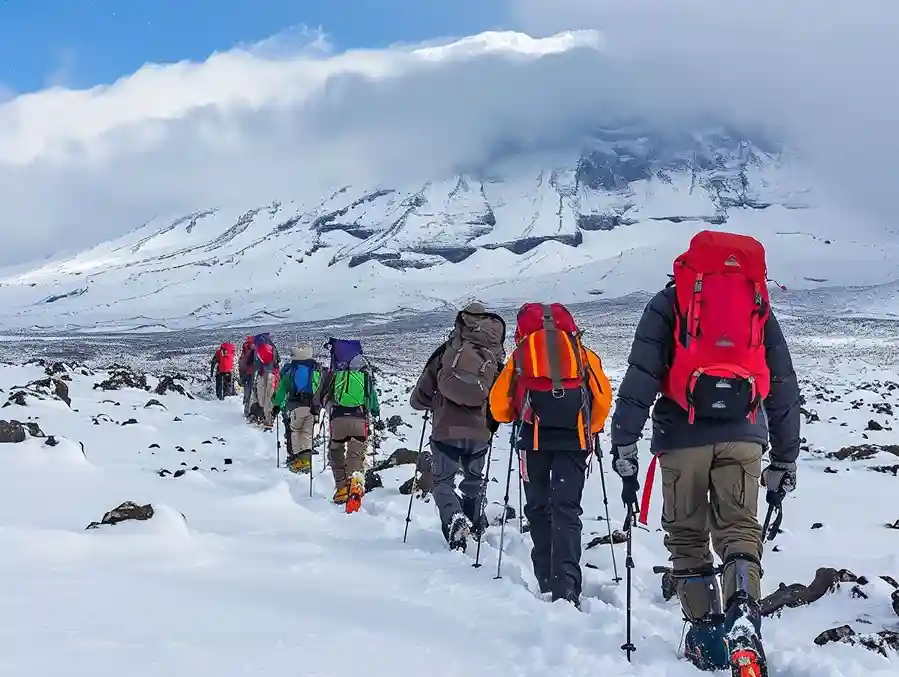
Search for what it costs to climb Kilimanjaro and you will find prices from under $1,500 to well over $6,000 for what looks like the same trip. It is not the same trip. The difference usually comes down to how many days you get, who looks after you on the mountain and how the crew is treated. A low price can cost you more if it means a rushed climb that does not reach the top.
With us, climbing Kilimanjaro costs from $1,600 to $2,580 per person, depending on how many days you spend on the mountain. This guide shows what that price includes, what you need to budget on top, and how to judge any quote you receive, ours included.
| Climb | Days | Starting price per person |
|---|---|---|
| Marangu | 5 | $1,600 |
| Machame, Marangu or Rongai | 6 | $1,845 |
| Machame, Lemosho or Rongai | 7 | $2,090 |
| Lemosho | 8 | $2,335 |
| Northern Circuit | 9 | $2,580 |
Prices are for two people sharing. A climber traveling alone pays slightly more, because they have a hotel room to themselves. Your final price is confirmed in your written quotation.
These go to Tanzania National Parks (TANAPA) and are the same for every operator. They are charged per person, mostly per day, so each extra day raises the cost. Published 2026 figures are roughly $70 per day in conservation fees, $50 per night for camping or $60 per night for huts, and a $20 rescue fee, although sources differ on whether VAT is included. On that basis, park fees for an 8-day climb come to around $1,000 per person. They are all included in our price.
Every climber on our Kilimanjaro climbs has one guide, five porters and one cook. A group of two therefore has two guides, ten porters and two cooks. That ratio is higher than many operators offer, and it means that if one climber needs to slow down or turn back, the other can continue with their own guide. Our guides have worked on Tanzania tours for 7 years. They are graduates of the College of African Wildlife Management, Mweka, and the National College of Tourism, and they hold certification from those institutions.
We carry pulse oximeters to track your blood-oxygen levels each day, emergency oxygen cylinders for emergency descents and severe altitude illness, and a Gamow bag, a portable pressure chamber used to treat advanced altitude sickness. These are part of your climb price.
Three meals a day and drinking water are included, along with tents, a dining tent and sleeping mats on camping routes. On Marangu, you sleep in huts.
Two nights in a mid-range Moshi hotel are included by default, one before and one after the climb. If you would prefer a different standard, tell us and we will adjust your quote. Your return airport transfer and the drives to and from the park gates are included too.
Yes, by about $245 per person for each extra day with us. That covers more park fees and crew days. It is also the best-value upgrade you can make, because time is what most improves your chances of feeling well at the top. Operators publish very different summit figures and none are independently audited, so treat any single number with caution. Commonly quoted ranges run from about 27 to 42 percent on 5-day climbs, and from about 64 to 92 percent on 7-day climbs, with 8 and 9-day climbs reported higher still. The exact figures matter less than the pattern: more days means better odds.
If your budget allows only one upgrade, make it a day on the mountain, rather than a nicer hotel or newer gear.
Park fees are fixed, so an operator cannot reduce them. When a quote is far below the others, the savings have to come from somewhere, and that usually means the crew, the food, the equipment or the number of days. Porters are often the first to pay for it.
We are also a partner of the Kilimanjaro Porters Assistance Project (KPAP), which works for the fair treatment of mountain crews. KPAP advises that a porter's load should not exceed 20 kg (44 lb), excluding personal kit, and that wages should be paid promptly after the climb.
A good operator answers all of these directly. Ours are on this page: TALA Licence No. 545789, and one guide, five porters and one cook per climber.
| Cost | What to expect |
|---|---|
| International flights | Varies by country and season. Kilimanjaro International Airport (JRO) is closest to Moshi. |
| Tanzania visa | US citizens pay $100, and many other nationalities pay $50. Check the official portal at visa.immigration.go.tz for your nationality. |
| Travel insurance | Required. It must cover trekking to 6,000 meters (19,685 feet) and evacuation. |
| Helicopter evacuation | Starts from $3,500 per person if needed, through providers including Kili MedAir and Proflight Helicopters. Check your insurance covers it. |
| Vaccinations and medication | See a travel clinic six to eight weeks before you travel, and ask about altitude medication and malaria tablets. |
| Gear | Bring your own or rent in Moshi. Ask us for current rental prices. |
| Tips | About $57 to $100 per climber per day with our crew of seven. For 7 days, that is about $400 to $700 per climber. |
| Extra nights and drinks | Any hotel nights beyond the two included, and drinks other than water. |
Tipping is expected on Kilimanjaro, and it is an important part of what the crew takes home. Common guidance from trekking companies is about $20 to $30 a day for a guide, $12 to $20 a day for a cook and $5 to $10 a day for each porter.
| Climb length | Typical tips per climber, with our crew of seven |
|---|---|
| 5 days | $280 to $500 |
| 6 days | $340 to $600 |
| 7 days | $400 to $700 |
| 8 days | $460 to $800 |
| 9 days | $510 to $900 |
KPAP encourages climbers to make sure tips reach each crew member openly and fairly, so we go through how to do this at your briefing. Bring US dollars in small, clean bills.
Here is a rough budget for a climber sharing with one other person on a 7-day climb, before flights.
| Item | Approximate cost |
|---|---|
| Climb price | $2,090 |
| Tips | $400 to $700 |
| Visa | $50 to $100 |
| Insurance | Varies by age and country |
| Gear rental | Depends on what you need |
The big variable is flights, which depend on where you are coming from and when you travel.
The cheapest climb is rarely the best value. A 5-day climb costs less, but it gives you the least time to adapt, so you risk paying for a summit you do not reach. Here is how to save without taking that risk.
The 5-day Marangu Route is our lowest price at $1,600 per person. We suggest a longer climb unless you have recent altitude experience.
Yes. All park fees for the climb are included.
The crew cost is per climber either way. The difference comes from having a hotel room in Moshi to yourself.
There is no maximum group size. Each climber has their own crew, so the price per person stays about the same. Ask us for a quote.
Helicopter evacuation starts from $3,500 per person. It is not included in the climb price, so make sure your insurance covers it.
Mostly because of the number of days, crew size and how the crew is treated, along with hotel standard and service level.
Do not compare totals alone. Compare days, crew numbers, what is included and how the crew is treated. Then ask for it in writing. Send us your route and dates, and we will send you a clear written quote to compare with any others you receive.
Tell us your route, dates and group size, and we will send a written quote.